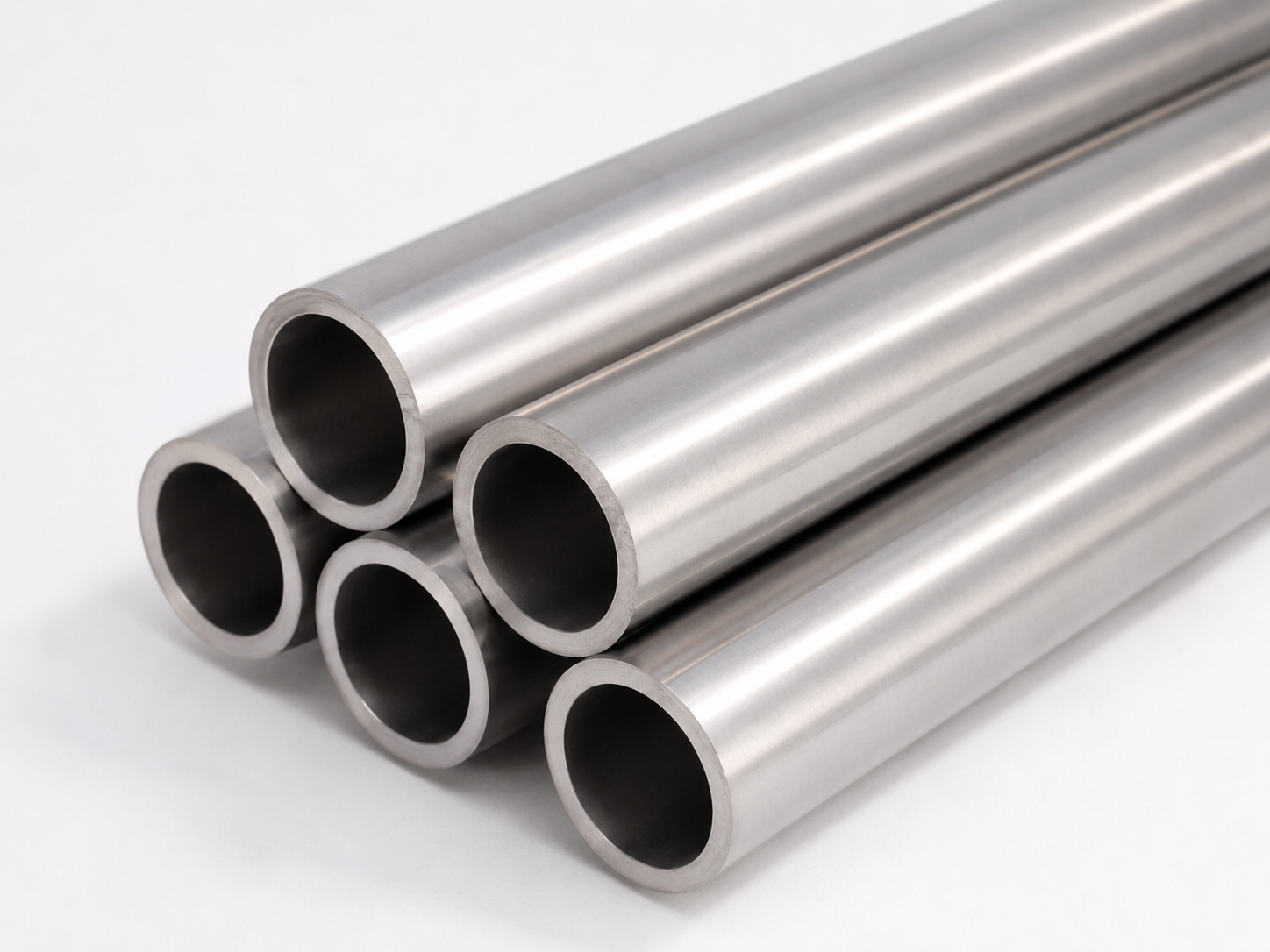
Grade 12 titanium pipe (UNS R53400, often described as Ti-0.8Ni-0.3Mo) is a lean titanium alloy developed to extend corrosion resistance and strength beyond commercially pure Grade 2 in selected process environments. For purchasing teams, the important point is not that Grade 12 is automatically “better” than Grade 2. The value of Grade 12 appears when the project corrosion review identifies specific risks—such as hot chloride brine, restricted crevices, reducing conditions, higher temperature or a need for greater strength—and the engineering specification approves the alloy for that duty.
This guide explains how to buy Grade 12 titanium pipe for chloride and brine service without turning the RFQ into a vague request for “corrosion-resistant titanium.” It covers the active ASTM routes for seamless pipe, welded pipe and welding fittings, the practical difference between Grade 2 and Grade 12, the service data suppliers need, inspection and documentation choices, and a complete RFQ checklist. Final material selection remains the responsibility of the owner, project engineer and applicable design code.
Quick RFQ Summary: What to Send for Grade 12 Titanium Pipe
| RFQ item | What to state | Why it matters |
|---|---|---|
| Material | Titanium Grade 12 / UNS R53400 | Prevents substitution with Gr2 or another corrosion-resistant grade |
| Service medium | Chloride solution, hot brine, seawater concentrate, process liquor, acid-containing brine, etc. | “Chloride service” alone does not define corrosion severity |
| Chemistry | Chloride concentration, total dissolved solids, pH, oxidizing/reducing species and contaminants | Trace species and aeration can change titanium corrosion behavior |
| Temperature / pressure | Normal, design and upset values | Crevice and general corrosion risk can increase as temperature rises |
| Product form | Seamless pipe, welded pipe, heat exchanger tube, fittings, flange/forging | Each form follows a different ASTM specification |
| Standard | ASTM B861, B862, B338, B363, B381 as applicable | Defines the product route, acceptance tests and documentation framework |
| Dimensions | NPS/OD, wall or schedule, length, ends, tolerances | Controls manufacturing route, material availability and freight |
| Inspection | Standard tests plus required NDT, PMI, TPI, witness/hold points | Extra testing should be priced before production |
| Documents | MTC, heat/lot traceability, dimensional report, NDT reports, EN 10204 3.1 if required | Documentation scope can materially affect lead time and cost |
What Is Grade 12 Titanium?
ASTM Grade 12 is UNS R53400, a titanium alloy containing nominally about 0.3% molybdenum and 0.8% nickel. Those small alloying additions distinguish it from commercially pure Grade 2. ASTM B861-24 lists Grade 12 as Ti with 0.3% molybdenum and 0.8% nickel, while TIMET describes Grade 12 as a lean alloy with higher strength than Grade 2 and improved resistance to crevice corrosion in hot brines.
For procurement purposes, three characteristics are especially relevant:
- More margin in selected hot-brine and crevice conditions: Grade 12 is often evaluated where commercially pure titanium approaches the limits of the project corrosion envelope.
- Higher strength than Grade 2: this can influence allowable wall, component design and total installed weight, but only after the applicable design code and engineering calculations are applied.
- Broad product availability: Grade 12 is included in ASTM specifications for seamless pipe, welded pipe, heat exchanger tube, welding fittings and forgings, allowing a project to specify a coordinated piping system.
Why Is Grade 12 Considered for Chloride and Hot Brine Service?
Titanium depends on a stable surface oxide film for corrosion resistance. In well-aerated seawater and many neutral chloride solutions, commercially pure titanium can perform extremely well. The more difficult cases are often localized conditions where oxygen replenishment is limited—tight gasket interfaces, deposits, flange faces, under-scale regions, stagnant pockets and other crevices—especially as temperature rises.
Grade 12 was developed to improve performance in such demanding environments. TIMET specifically notes a significant improvement over unalloyed titanium for crevice corrosion in hot brines. The International Titanium Association likewise notes that alloying additions such as nickel and molybdenum in Grade 12 can extend titanium's useful corrosion envelope when service temperature is higher or crevices cannot be designed out.
Typical project situations where Grade 12 may enter the materials review
- Hot concentrated brine, including evaporative or process-concentrated chloride streams.
- Brine piping with unavoidable gasketed, threaded, lap-joint or deposit-forming crevices.
- Chemical process liquor containing chlorides plus acids or reducing contaminants.
- Hydrometallurgical piping, heat exchangers and pressure-process systems where both corrosion resistance and higher strength are useful.
- Seawater or brine systems operating above the temperature range normally assigned to commercially pure titanium by the project corrosion engineer.
None of these examples is a blanket material approval. Buyers should provide the actual process chemistry and request confirmation against the owner's material specification, corrosion study or relevant industry standard.
Grade 12 vs Grade 2 Titanium: What Changes for the Buyer?
| Procurement factor | Grade 2 / UNS R50400 | Grade 12 / UNS R53400 |
|---|---|---|
| Alloy type | Commercially pure titanium | Titanium with nominal Ni + Mo additions |
| Typical buying logic | Default workhorse for many corrosion-resistant piping and seawater applications | Selected when project conditions require extra crevice/hot-brine margin or higher strength |
| Hot-brine crevice resistance | Good in many services but project limits must be respected | Generally improved relative to unalloyed titanium |
| Strength | Lower than Grade 12 | Higher than Grade 2 |
| Material cost / availability | Usually broader availability and lower alloy premium | Often higher price and may require more project-specific sourcing |
| Best RFQ practice | Specify Gr2 only when approved by project materials selection | Specify Gr12 explicitly—do not accept Gr2 substitution without engineering approval |
For a sourcing team, this comparison means that “upgrade everything to Grade 12” is not automatically the lowest-risk strategy. It may add cost without solving a poorly defined service condition. The better approach is to define the corrosion environment, let engineering select the grade, then procure that grade consistently across the relevant pipe, fittings, flanges and heat-transfer components.
For a wider comparison, see our Grade 2 vs Grade 12 titanium buyer guide.
ASTM Standards for Grade 12 Pipe, Tube, Fittings and Forgings
The word “pipe” is frequently used loosely in inquiries. A complete project may actually contain process pipe, condenser tube, elbows, reducers, stub ends and forged flanges. The ASTM standard must match the product form.
| Product form | Current ASTM route | Buyer use |
|---|---|---|
| Seamless titanium pipe | ASTM B861-24 | General corrosion-resisting and elevated-temperature seamless pipe; includes Grade 12 / UNS R53400 |
| Welded titanium pipe | ASTM B862-23 | Welded pipe from flat-rolled titanium for general corrosion-resisting and elevated-temperature service; Grade 12 is furnished annealed |
| Heat exchanger / condenser tube | ASTM B338-17(2026) | Seamless and welded tubes for surface condensers, evaporators and heat exchangers |
| Butt-welding fittings | ASTM B363-23 | Elbows, tees, reducers, caps, returns, lap-joint stub ends and other welding fittings |
| Forgings / forged flange material | ASTM B381-26 | Annealed titanium and titanium-alloy forgings, including Grade F-12 |
ASTM B861 Grade 12 seamless pipe
ASTM B861-24 covers seamless titanium and titanium-alloy pipe for general corrosion-resisting and elevated-temperature service. The standard includes Grade 12 as UNS R53400. Its requirements include chemical analysis, mechanical properties and specified tests such as tension, flattening, bend and hydrostatic testing. Buyers should state any additional NDT or project-specific acceptance criteria in the purchase order.
ASTM B862 Grade 12 welded pipe
ASTM B862-23 is the companion route for welded pipe. The ASTM scope states that Grade 12 welded pipe is furnished annealed. Large welded titanium pipe can be attractive where the project needs diameter or wall combinations that are difficult or uneconomic to source seamlessly. The standard also recognizes that larger NPS pipe is frequently custom made, which makes a detailed dimensional and inspection specification especially important.
ASTM B363 fittings and B381 forgings
A Grade 12 line should not stop at the straight pipe. Elbows, tees, reducers and stub ends are typically ordered to ASTM B363 where applicable, while forged components may use ASTM B381 Grade F-12 as the material route. The piping class, dimensional standard and pressure design rules still need to be stated separately.
Service Data That Must Be Defined Before Ordering
A strong RFQ gives the supplier enough process context to quote the specified material without pretending to perform the owner's corrosion engineering. For chloride and brine systems, include the following information whenever available.
| Service variable | What the buyer should provide | Why it matters |
|---|---|---|
| Chloride / salinity | mg/L, wt%, total dissolved solids or brine concentration | Defines the chloride severity and helps distinguish seawater from concentrated process brine |
| Temperature | Normal, maximum, design and upset temperature | Localized-corrosion and crevice risk may increase with temperature |
| pH | Normal range and credible excursions | Acidic or alkaline chemistry can materially change the corrosion environment |
| Aeration / oxygen | Aerated, deaerated, vacuum, stagnant zones | Titanium passivity and crevice behavior depend partly on oxidizing conditions |
| Other species | H2S, acids, oxidizers, reducing salts, iron/copper ions, chlorine treatment, organics | Mixed chemistry can be more important than chloride concentration alone |
| Solids / deposits | Suspended solids, scale tendency, slurry content | Deposits can create shielded areas and erosion/impingement concerns |
| Geometry | Gaskets, lap joints, threaded areas, dead legs, tight deposits, tube-sheet interfaces | Crevice geometry is central to Grade 12 selection in many hot-brine systems |
| Cleaning | CIP chemicals, acid wash, chlorination, biocide and frequency | Short-duration cleaning chemistry may be more severe than normal operation |
Choosing the Product Form: Seamless, Welded, Fittings and Flanges
Grade 12 seamless pipe
Titanium seamless pipe is typically selected where the piping specification calls for ASTM B861, where seamless construction is preferred, or where size and wall combinations are available through seamless manufacturing. Buyers should state whether the quoted dimensions are NPS/schedule or actual OD × wall.
Grade 12 welded pipe
Titanium welded pipe can be practical for project quantities and larger diameters. For welded Grade 12, the RFQ should define weld quality requirements, annealed condition, any radiography/ultrasonic/penetrant requirements beyond the ASTM base specification, and whether the client or third party will witness testing.
Grade 12 pipe fittings
Titanium pipe fittings should match the project piping class and approved material grade. State fitting type, angle, size, wall/schedule, end preparation, ASTM material specification and dimensional standard. For reducers, state concentric or eccentric. For lap-joint systems, define stub-end geometry and mating flange requirements.
Grade 12 flanges and forged components
Titanium flanges introduce additional purchasing details: type, pressure class, facing, drilling standard, dimensions and whether solid titanium or another approved construction is required. The material route may use ASTM B381 F-12 for applicable forgings, but the finished flange must also meet the project dimensional and pressure-design specification.
Dimensions and Ordering Details That Change Price
Two Grade 12 inquiries with the same nominal size can have very different manufacturing cost. The most common quotation variables are:
- NPS or OD: state the system used and do not mix nominal pipe size with outside diameter.
- Wall thickness: schedule, nominal wall or minimum wall basis should be explicit.
- Length: random, double-random or fixed lengths; state tolerance for fixed-length pieces.
- Ends: plain, beveled, square-cut or project-specific weld preparation.
- Surface: pickled, cleaned, polished or as-produced according to the PO.
- Quantity: total meters/pieces by each size rather than only total project weight.
- Fabrication: bends, spools, welded branches, prefabricated assemblies and special machining should be separated from bare-material supply.
For large or nonstandard welded pipe, provide drawings early. ASTM B862 notes that 8 in. NPS and larger pipe is frequently custom made, so wall thickness, testing and acceptance requirements should be agreed before production rather than inferred after the pipe is complete.
QA, Testing and Documentation for Grade 12 Titanium
The basic ASTM specification is only the starting point. Industrial buyers often need a project-specific inspection and document package. State these requirements in the RFQ so every supplier quotes the same scope.
| QA / document item | Typical buyer instruction | Procurement note |
|---|---|---|
| Material certificate | MTC showing heat/lot, chemistry, mechanical properties and applicable standard | Specify EN 10204 3.1 only if your PO/project requires it |
| Traceability | Heat/lot marking on pipe and transfer of identification to cut lengths | Critical for project material control and later field verification |
| PMI | Positive material identification if required | Define sampling rate and accepted method; Grade 12 should be distinguishable from Gr2 by alloy content |
| Dimensional inspection | OD/NPS, wall, length, straightness, end prep, fittings dimensions | Ask for report format if the client needs a dossier |
| NDT | UT, RT, PT or other method where required by project specification | Do not assume every extra NDT method is included in the base ASTM price |
| Pressure / hydro testing | Per governing ASTM and project requirements | Clarify any special pressure, hold time or witnessing requirement |
| Third-party inspection | Agency, stage, witness/hold points and document review | Schedule TPI before material is packed |
| Surface / cleanliness | Pickling, cleaning, contamination controls, packaging | Important when material enters high-purity or sensitive process service |
Why traceability matters especially for Grade 12
Grade 12 and Grade 2 can appear similar visually. A project that intentionally selected Grade 12 for its alloyed corrosion behavior should preserve material identity through cutting, fabrication, fittings and final packing. Heat/lot traceability, MTC review and, where specified, PMI help reduce the risk of a lower-alloy material entering the line.
Complete Grade 12 Titanium Pipe RFQ Table
Copy this information into your inquiry
| Buyer field | Example of a complete requirement |
|---|---|
| Product | Grade 12 titanium seamless pipe |
| Material grade | ASTM Grade 12 / UNS R53400 |
| Standard | ASTM B861-24 |
| Size | OD × wall or NPS × schedule; list each line item |
| Length | Fixed / random; quantity per length |
| Ends | Plain / beveled with required angle or project detail |
| Service | Hot chloride brine; include composition, temperature, pressure, pH and upset conditions |
| Condition | As required by the governing ASTM / project specification |
| Testing | ASTM base tests plus project NDT/PMI/TPI requirements |
| Documents | MTC, traceability, dimensional report, NDT reports, EN 10204 3.1 if required |
| Quantity | Pieces / meters for each size |
| Delivery | Destination, Incoterm, required date and packing requirements |
Send the above information through our RFQ form or email yyang990620@gmail.com. If drawings or a material requisition are available, attach them so size, inspection and documentation are quoted against the same project basis.
Common Purchasing Mistakes with Grade 12 Titanium Pipe
- Ordering “titanium pipe” without the grade. Grade 2 and Grade 12 are not interchangeable without project approval.
- Specifying only chloride concentration. Temperature, pH, oxygen condition, crevices and other species can be equally important.
- Using a tube standard for process pipe. ASTM B338 is for condenser/heat-exchanger tube; ASTM B861/B862 are the relevant pipe routes.
- Ignoring fittings and flanges. A Grade 12 straight run with an unapproved fitting or flange material defeats the material-control plan.
- Adding NDT after order placement. Inspection changes can affect manufacturing sequence and cost.
- Comparing quotations with different documentation. One supplier may include TPI, PMI and a 3.1 dossier while another quotes only standard mill certification.
- Failing to preserve traceability after cutting. Marking and heat/lot transfer should be part of the fabrication plan.
FAQ: Grade 12 Titanium Pipe for Chloride and Brine
Is Grade 12 titanium better than Grade 2 for chloride service?
Not in every chloride service. Grade 2 is already a strong performer in many aerated seawater and neutral chloride environments. Grade 12 is usually considered when the project needs additional hot-brine or crevice-corrosion margin, higher strength, or another specific benefit supported by the corrosion review.
What is the UNS number for Titanium Grade 12?
Grade 12 is UNS R53400. It is commonly described as Ti-0.8Ni-0.3Mo based on its nominal nickel and molybdenum additions.
Which ASTM standard applies to Grade 12 seamless titanium pipe?
ASTM B861-24 is the active ASTM specification for titanium and titanium-alloy seamless pipe and includes Grade 12 / UNS R53400.
Which ASTM standard applies to Grade 12 welded titanium pipe?
ASTM B862-23 is the active specification for welded titanium and titanium-alloy pipe. Grade 12 welded pipe is supplied in the annealed condition under the specification.
Can Grade 12 be used for titanium pipe fittings?
Grade 12 can be supplied in welding fittings under the appropriate ASTM B363 product grade and project piping specification. Buyers should specify the exact fitting type, size, wall/schedule, dimensional standard and inspection scope.
Is Grade 12 suitable for hot brine?
Grade 12 was developed in part to improve titanium performance in demanding corrosion conditions, and producer data highlight improved crevice-corrosion resistance in hot brines versus unalloyed titanium. Suitability for a specific brine still requires review of temperature, pH, chloride level, oxygen condition, other chemicals and geometry.
Should I request PMI for Grade 12?
PMI is not automatically required for every order, but it can be valuable when the project must verify alloy identity and prevent mix-up with commercially pure titanium. State the PMI method, sampling rate and acceptance requirements in the RFQ if the project requires it.
What information is most important for a Grade 12 quotation?
At minimum send grade, ASTM specification, product form, size, wall/schedule, length, quantity, service description, inspection scope, documents and delivery destination. For corrosion-sensitive projects, also include the process chemistry and temperature so the commercial discussion is based on the actual application.
Related Grade 12 and Titanium Pipe Buyer Guides
Technical References
- ASTM B861-24 — Titanium and Titanium Alloy Seamless Pipe
- ASTM B862 — Titanium and Titanium Alloy Welded Pipe
- ASTM B363-23 — Titanium Welding Fittings
- ASTM B381-26 — Titanium and Titanium Alloy Forgings
- TIMETAL Grade 12 technical data
- International Titanium Association — Titanium in Seawater Service
Need Grade 12 titanium pipe, fittings or flanges?
Send the ASTM specification, size, wall/schedule, quantity, service conditions, inspection scope and delivery destination. TAILIDEXIN can review the commercial supply scope for Grade 12 titanium products.