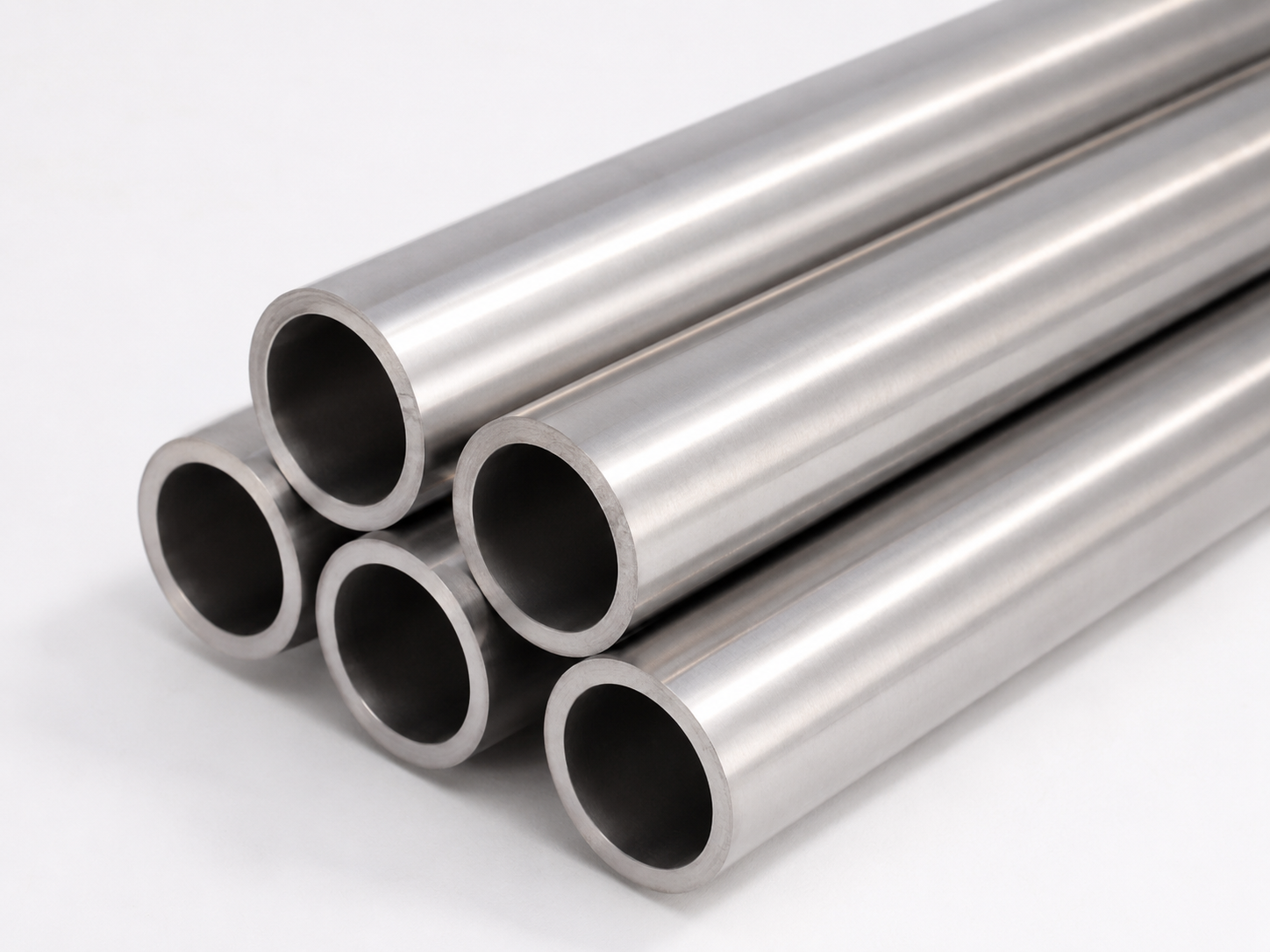
A request for “Grade 2 titanium seamless pipe” is still incomplete if the buyer does not define the governing standard, dimensions, quantity, testing and documentation. For corrosion-resistant process piping, ASTM B861 titanium seamless pipe is an important specification to understand because it is written for seamless titanium and titanium-alloy pipe used in general corrosion-resisting and elevated-temperature service.
ASTM International currently lists ASTM B861-24 as the active edition. The specification covers multiple titanium grades and requires conformance to chemical and mechanical requirements, together with specified testing. This guide focuses on how purchasing teams can convert those requirements into a clear RFQ—especially for Grade 2 titanium, while also explaining where Gr1, Gr9 and Gr12 fit into a sourcing discussion.
What Does ASTM B861 Cover?
ASTM B861 is a specification for titanium and titanium-alloy seamless pipe. ASTM describes the scope as general corrosion-resisting and elevated-temperature service. The active ASTM B861-24 listing includes 34 grades, among them Grade 1, Grade 2, Grade 9 and Grade 12. Buyers can review the current standard listing directly at ASTM International.
From a purchasing perspective, the word seamless matters. A supplier should not substitute a welded product when the RFQ, drawing or material specification requires ASTM B861 seamless pipe. Likewise, a buyer should not copy a heat-exchanger tube specification into a process-pipe RFQ simply because both products are titanium and both may be described using outside diameter and wall thickness.
| Procurement item | What should be written in the RFQ? |
|---|---|
| Product form | Seamless titanium pipe |
| Governing standard | ASTM B861 plus the project-required edition or customer specification |
| Grade | Exact grade, such as Gr2 / UNS R50400, when required by the drawing or material specification |
| Dimensions | Pipe size basis, OD, wall thickness or schedule, and finished length as applicable |
| Quantity | Pieces, total length or project quantity with any lot split |
| Testing | Standard tests plus any additional NDT, pressure test, PMI or project inspection requirement |
| Documents | MTC / material certificate, dimensional report and any third-party documentation required by the PO |
| Service data | Fluid, temperature, design pressure and corrosion environment for technical review |
Procurement note: ASTM B861 defines a material/product specification. It does not replace the piping designer’s responsibility to select the correct grade, wall thickness, pressure design basis, corrosion allowance and code requirements for the actual system.
ASTM B861 vs ASTM B338: Do Not Mix Pipe and Heat Exchanger Tube Requirements
One of the most common titanium purchasing errors is treating ASTM B861 and ASTM B338 as interchangeable. They address different product intents. ASTM B861 is for seamless titanium pipe used in corrosion-resistant and elevated-temperature service, while ASTM B338 covers seamless and welded titanium tubes for condensers, evaporators and heat exchangers.
| Question | ASTM B861 | ASTM B338 |
|---|---|---|
| Primary product | Seamless titanium / titanium-alloy pipe | Seamless and welded titanium / titanium-alloy tube |
| Typical buying intent | Process piping, corrosion-resistant transfer lines and general pipe service | Condenser, evaporator and heat exchanger tubing |
| Manufacturing route | Seamless | Seamless or welded, depending on the requirement |
| Best first question | What pipe standard, grade and size does the piping design require? | What tube standard, grade, OD, wall and exchanger drawing require? |
| Related TAILIDEXIN page | Titanium Seamless Pipe | Titanium Heat Exchanger Tube |
If your project is actually sourcing condenser or exchanger tubing, use our ASTM B338 titanium heat exchanger tube buyer guide instead. This separation helps purchasing teams avoid sending a technically ambiguous inquiry to multiple suppliers.
Grade Selection: Gr1, Gr2, Gr9 and Gr12 for Seamless Titanium Pipe
The correct titanium grade comes from corrosion, mechanical and design requirements—not from a supplier’s general recommendation alone. The four grades below are already part of the TAILIDEXIN product structure and can be discussed during procurement, but the final material selection should follow the project specification and engineering review.
| Grade | ASTM B861 identity | Buyer-oriented selection note |
|---|---|---|
| Gr1 | Commercially pure titanium / UNS R50250 | Lower-strength commercially pure grade with high ductility. Use when the project specifically requires Grade 1 and its strength/formability balance is suitable. |
| Gr2 | Commercially pure titanium / UNS R50400 | A common general-purpose corrosion-resistant grade. Buyers frequently search for ASTM B861 Grade 2 titanium seamless pipe for chemical and industrial piping applications. |
| Gr9 | Ti-3Al-2.5V / UNS R56320 | Higher-strength titanium alloy. It should be selected because the engineering specification needs its property balance, not simply because “higher grade” sounds better. |
| Gr12 | Ti-0.3Mo-0.8Ni / UNS R53400 | Corrosion-resistant alloy grade used for more demanding process environments when the project corrosion review specifically calls for Grade 12. |
Why Grade 2 is often the first commercial discussion
Grade 2 titanium seamless pipe is widely recognized in industrial procurement because it balances corrosion resistance, fabrication practicality and general mechanical performance for many chemical, marine and process applications. That does not make it universally suitable. Buyers should still identify the actual fluid composition, concentration, temperature, pressure, oxygen level, deposits, crevice conditions and cleaning chemistry when the service is corrosive.
When should a buyer ask about Gr12?
A buyer may encounter Gr12 titanium seamless pipe when a corrosion study or project material specification calls for its titanium-molybdenum-nickel alloy chemistry. Do not replace Gr2 with Gr12—or Gr12 with Gr2—without engineering approval. A material change can affect cost, availability, welding procedure requirements and the corrosion basis of the system.
Dimensions and Technical Parameters: What Buyers Need to Define
An RFQ that states only “2-inch titanium seamless pipe” leaves too much room for interpretation. Different markets and projects use nominal pipe size, outside diameter, schedule, nominal wall thickness or minimum wall requirements differently. The purchase document should make the dimensional basis explicit.
- Nominal size / NPS: include it if the project piping specification is schedule based.
- Outside diameter: state the actual OD when the drawing controls by OD rather than nominal pipe size.
- Wall thickness: define schedule, nominal wall or minimum wall exactly as the design requires.
- Length: specify random, fixed or cut length and the permitted tolerance.
- End condition: plain end, bevel, square cut, deburred or prepared for a downstream fabrication step.
- Surface condition: indicate pickled, polished, cleaned or project-specific finish when required.
- Straightness / ovality: add tighter drawing limits when assembly or fabrication needs them.
- Marking and traceability: define heat/lot identification and tagging expected at delivery.
Do not invent a “standard stock size” in the purchase order
Stock programs vary by mill, grade and market. If a certain OD × wall thickness is essential, put the exact requirement in the RFQ and ask the supplier to quote the closest available production route only as an alternate. This prevents a commercial comparison where one quotation is based on the exact project size and another is based on a “nearby” size that later requires design approval.
Testing, Inspection and Documentation Under ASTM B861
ASTM’s current B861 listing states that chemical and product analysis are required, mechanical requirements cover tensile strength, yield strength and elongation, and the specification includes tension, flattening, bend and hydrostatic testing. The exact purchase order should still state the required standard edition and any project additions so the supplier knows which inspection scope to price.
| Inspection / document | What the buyer should clarify |
|---|---|
| Chemical composition | Grade compliance and heat/lot traceability on the material certificate |
| Mechanical properties | Tensile, yield and elongation requirements per the applicable specification |
| Flattening / bend tests | Acceptance per the standard and any project-specific additions |
| Hydrostatic test | Confirm the standard/PO requirement, test basis and documentation expected |
| Dimensional inspection | OD, wall, length, straightness and any drawing-specific dimensions |
| PMI / additional NDT | State whether project procedures require positive material identification or other NDT beyond the base specification |
| MTC / certificate | Specify certificate type, heat number traceability and required reported test results |
| Third-party inspection | Name the inspection agency, hold/witness points and document review scope before quotation |
For international orders, documentation requirements can materially affect lead time. If your project needs third-party witness, additional NDT, special marking, country-of-origin documents or customer-specific inspection forms, include them before price confirmation rather than after production starts.
Procurement Table: RFQ Template for ASTM B861 Titanium Seamless Pipe
The table below is designed for purchasing teams comparing multiple suppliers. Replace the example values with the actual engineering requirement rather than copying them into a live purchase order.
| RFQ field | What to specify | Example format |
|---|---|---|
| Product | Seamless titanium pipe | Titanium seamless pipe |
| Standard | ASTM B861 + project-required edition/specification | ASTM B861 |
| Grade | Exact titanium grade / UNS if required | Gr2 / UNS R50400 |
| Size | NPS or OD, as controlled by the design | OD 60.3 mm |
| Wall | Schedule, nominal wall or minimum wall | 3.91 mm nominal |
| Length | Random or fixed length + tolerance | 6,000 mm fixed |
| Quantity | Pieces / meters / total project quantity | 120 pcs |
| Ends | Plain / bevel / square cut / special preparation | Plain ends, deburred |
| Service | Fluid, concentration, temperature, pressure and application | Chemical process transfer line |
| Testing | ASTM tests + project additions | Per ASTM B861 + PO requirements |
| Documents | MTC, dimensional report, NDT/pressure reports if applicable | MTC + dimensional report |
| Packing | Export packing and end protection | Seaworthy export packing |
| Delivery | Incoterm, destination and requested date | FOB / CIF + destination port |
Seven Common Titanium Seamless Pipe Buying Mistakes
- Writing “titanium pipe” without the product standard. This can lead suppliers to quote different product forms or compliance scopes.
- Using ASTM B338 when the project actually calls for ASTM B861 pipe. Heat exchanger tube and process pipe should not be merged into one generic requirement.
- Leaving grade selection open. “Industrial titanium” or “seawater titanium” is not an adequate material grade.
- Sending only NPS without the dimensional basis. State schedule or exact OD/wall so every supplier prices the same item.
- Adding inspection after quotation. Extra PMI, NDT, third-party witness or special documents can change both cost and lead time.
- Ignoring fabrication compatibility. End preparation, weld procedure, fittings and flanges should be checked as a piping system, not as isolated line items.
- Comparing only price per kilogram. Compare compliance, usable length, testing, certificates, packing and delivery terms before selecting the lowest commercial number.
Related Titanium Products and Procurement Guides
FAQ: ASTM B861 Titanium Seamless Pipe
What is ASTM B861 used for?
ASTM B861 is a specification for titanium and titanium-alloy seamless pipe intended for general corrosion-resisting and elevated-temperature service. Buyers should identify the project-required edition and any additional customer specification in the purchase order.
Is Grade 2 covered by ASTM B861?
Yes. ASTM B861-24 lists Grade 2 / UNS R50400, along with many other titanium grades including Grade 1, Grade 9 and Grade 12.
What is the difference between ASTM B861 and ASTM B338?
ASTM B861 covers seamless titanium pipe, while ASTM B338 covers seamless and welded titanium-alloy tubes for condensers, evaporators and heat exchangers. Use the product specification called out by the project design.
What should I send when requesting a Grade 2 titanium seamless pipe quotation?
Send the standard, grade, exact size basis, wall thickness or schedule, length, quantity, end condition, service conditions, testing, documentation, packing, delivery term and destination.
Can I specify “titanium pipe for seawater” without a grade?
No. Seawater service alone is not a complete grade specification. Temperature, crevices, deposits, flow conditions, contamination and cleaning chemistry can influence material selection, so use the grade approved by the project corrosion review.
Does ASTM B861 require testing?
ASTM’s current listing describes chemical/product analysis, mechanical property requirements and tension, flattening, bend and hydrostatic tests. The purchase order should also identify any additional project inspections or documentation.
Can TAILIDEXIN quote custom OD, wall and fixed length?
Send the required ASTM standard, grade, OD or nominal size, wall thickness, fixed length, quantity and tolerances. We can review the requested configuration and confirm the quotation basis and available production route.
Request an ASTM B861 Titanium Seamless Pipe Quotation
Send TAILIDEXIN your ASTM standard, titanium grade, OD/NPS, wall thickness, finished length, quantity, service conditions, inspection requirements and destination. A complete RFQ allows us to compare your requirement against the correct product route before pricing.
Technical information in this article is intended to support procurement communication. Final grade selection, pressure design, corrosion suitability, code compliance and acceptance criteria should follow the project engineer, applicable code, current standard edition and purchase specification.