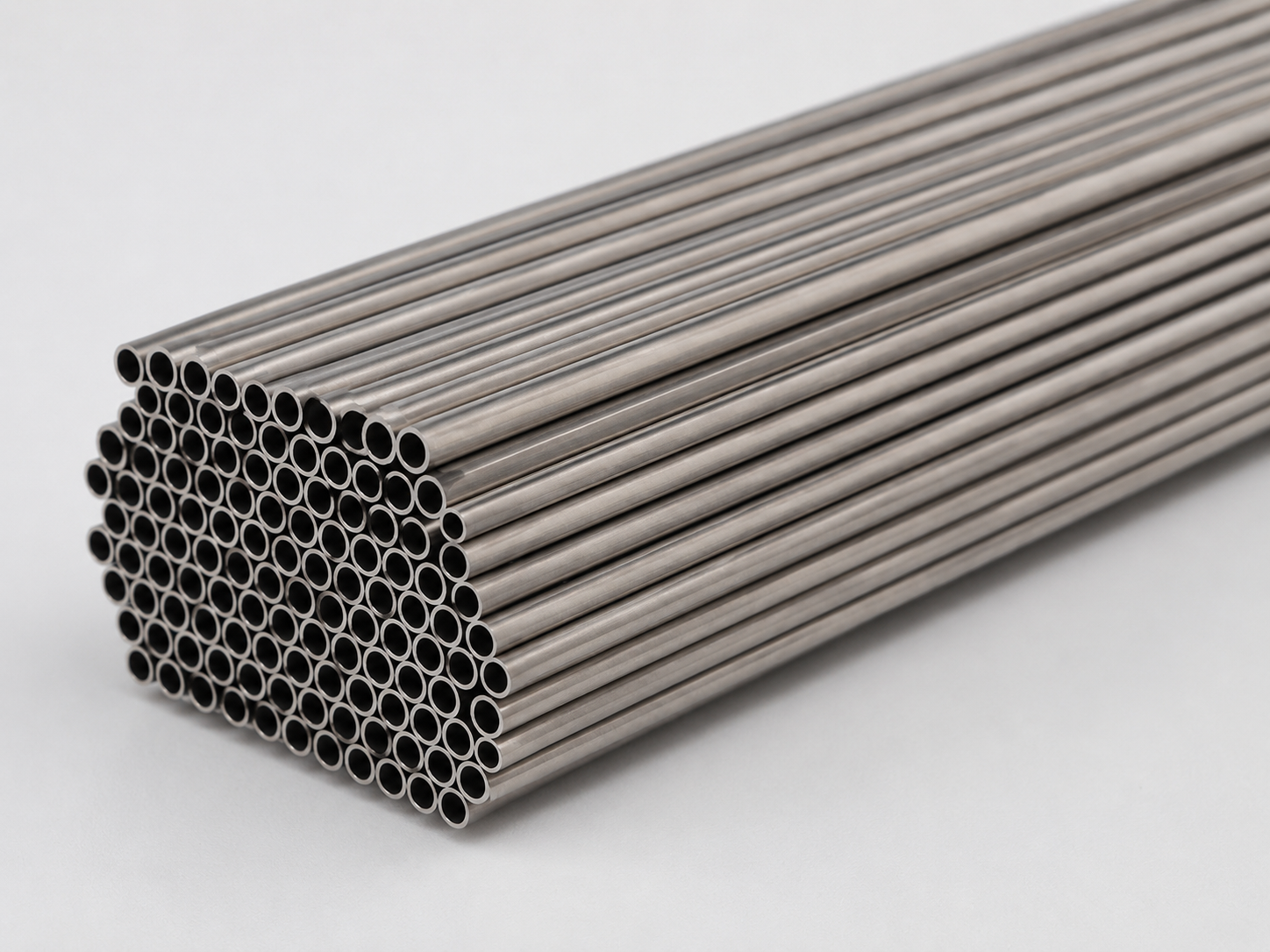
For a buyer, the phrase “titanium heat exchanger tube” is not a complete specification. Two quotations can look similar while referring to different grades, manufacturing routes, tolerances, testing scopes or documentation. A usable RFQ should identify the applicable tube standard first, then define the grade, outside diameter, wall thickness, finished length, quantity and inspection requirements.
ASTM B338 is the principal ASTM specification for seamless and welded titanium and titanium-alloy tubing intended for surface condensers, evaporators and heat exchangers. The current ASTM listing is ASTM B338-17(2026). For buyers searching for an ASTM B338 titanium tube, a Grade 2 titanium heat exchanger tube or a titanium condenser tube, the important question is not only whether a supplier mentions the standard—it is whether the quotation and final material documentation match the exact purchase requirement.
What Does ASTM B338 Cover for Titanium Heat Exchanger Tubes?
ASTM B338 covers titanium and titanium-alloy tubes intended for heat-transfer equipment such as surface condensers, evaporators and heat exchangers. The standard includes both seamless and welded tube routes and defines requirements for chemistry, mechanical properties, manufacturing, heat treatment and specified testing. The active 2026 ASTM listing covers 28 titanium grades.
This distinction matters because tube and pipe specifications are not interchangeable purchasing language. A heat exchanger drawing that calls for ASTM B338 tubing should not automatically be converted to a general process-pipe specification just because the nominal alloy is the same. If your project drawing, equipment datasheet or customer specification names a particular ASTM edition or additional acceptance criteria, those requirements should be repeated on the purchase order.
| Procurement item | What the buyer should confirm |
|---|---|
| Product form | Heat exchanger / condenser tube, not merely “titanium pipe” |
| Standard | ASTM B338 and the project-required edition or customer specification |
| Manufacturing route | Seamless, welded, or the route stated by the equipment design |
| Grade | Exact titanium grade and UNS designation when required |
| Dimensions | OD × wall thickness × finished length, plus tolerances |
| Inspection | NDT, pressure/leak testing, dimensional checks and any project-specific hold points |
| Documents | Mill test certificate and any additional inspection reports required by the PO |
Gr1 vs Gr2 vs Gr9 vs Gr12: Which Titanium Grade Should a Buyer Specify?
TAILIDEXIN currently presents Titanium Gr1, Titanium Gr2, Titanium Gr9 and Titanium Gr12 as core titanium grades. All four appear within the scope of ASTM B338, but they are not substitutes for one another. Grade selection should come from the equipment design, corrosion review, operating temperature, pressure, fabrication requirements and customer specification.
| Grade | Material type | Buyer-oriented selection note |
|---|---|---|
| Gr1 | Commercially pure titanium | Lower strength with high ductility and formability. Specify when the design specifically calls for Grade 1 or when forming requirements and service conditions support it. |
| Gr2 | Commercially pure titanium | A widely specified general-purpose titanium grade for corrosion-resistant equipment. Commonly considered for heat exchanger and condenser service when the design and corrosion conditions allow. |
| Gr9 | Ti-3Al-2.5V alloy | Higher-strength titanium alloy. Use when the engineering specification requires its strength/property balance rather than assuming it is a direct upgrade from commercially pure grades. |
| Gr12 | Ti-0.3Mo-0.8Ni alloy | Corrosion-resistant titanium alloy used in more demanding process environments when the corrosion assessment and design specifically call for Grade 12. |
For titanium tubes for seawater heat exchangers, buyers often begin the material discussion with commercially pure titanium because of titanium’s established use in chloride-containing cooling environments. But seawater is not one fixed condition: temperature, flow velocity, deposits, crevices, contamination, galvanic couples and cleaning chemistry can change the corrosion risk. Material selection should therefore be confirmed against the actual service data rather than chosen from a generic “seawater grade” label.
Do not change grades only to reduce quotation price
If a drawing calls for Gr12, quoting Gr2 as a cheaper alternative without engineering approval creates a technically different offer. The reverse is also true: automatically offering a higher-strength alloy can add unnecessary cost and may introduce different fabrication or availability considerations. A professional titanium heat exchanger tube supplier should quote the requested grade clearly and identify any proposed alternative as an alternative—not silently substitute it.
Dimensions and Technical Parameters Buyers Should Put on the RFQ
A complete tube size is normally communicated as outside diameter (OD) × wall thickness × finished length. Do not send only “25 mm titanium tube” because that leaves the wall thickness, tolerance and length unresolved. Heat exchanger work often depends on dimensional consistency for tube-sheet holes, expansion, orbital welding, bundle assembly and final leak integrity.
Core dimensional fields
- Outside diameter: state the exact OD shown on the exchanger drawing.
- Wall thickness: specify nominal or minimum wall as required by the engineering document.
- Finished length: define cut length and any permitted length tolerance.
- OD and wall tolerances: reference ASTM/project requirements and any tighter drawing tolerance.
- Straightness: add a project limit if bundle assembly requires tighter control.
- End condition: square cut, deburred, cleaned, or prepared for a downstream process.
- Surface condition: state whether a specific finish, cleanliness level or visual acceptance is required.
Do not copy a “typical size range” from a supplier website into the purchase order. The correct size is the one required by your equipment calculation and drawing. If the project is still at budget stage, clearly mark dimensions as preliminary so the supplier knows the quotation may need revision after design freeze.
Seamless or Welded Titanium Heat Exchanger Tube?
ASTM B338 includes both seamless and welded titanium tube. The correct manufacturing route depends on the project specification, grade, size, service, inspection philosophy and equipment designer’s requirements.
Seamless titanium heat exchanger tube is produced from hollow starting material through cold-reduction or cold-drawing routes. Welded titanium heat exchanger tube starts from flat-rolled material and is welded under a controlled automatic process, followed by processing and heat treatment as required by the specification. Buyers should avoid reducing this decision to “seamless is always better.” A compliant welded tube and a compliant seamless tube are different manufacturing routes; project suitability is determined by the governing specification and engineering requirements.
If your inquiry permits either route, say so. If it requires seamless only, put “SEAMLESS ONLY” directly in the RFQ and purchase order. This prevents a technically compliant but commercially unacceptable alternative from appearing later in the sourcing process.
Testing, Inspection and Material Documentation
ASTM B338 contains different test provisions depending on the tube manufacturing route. The ASTM summary for the current edition describes flattening requirements and route-dependent nondestructive and pressure/leak testing. Buyers should use the current standard and project specification to define the exact acceptance scope rather than relying on a supplier’s generic inspection list.
What to state in the purchase requirement
- Applicable ASTM B338 edition and any supplementary project specification.
- Required nondestructive examination and acceptance criteria.
- Hydrostatic, pneumatic or other leak/pressure testing when required by the standard or PO.
- Dimensional inspection points and sampling plan.
- Visual and surface acceptance requirements.
- Material identification / traceability requirements.
- Mill test certificate requirements and any third-party inspection requirement.
- Marking, tagging and heat/lot traceability expected at delivery.
For critical exchanger bundles, the buyer may also have tube-sheet fit-up criteria, additional cleanliness controls, project-specific eddy-current acceptance, witness points or third-party inspection. These should be specified before the final quotation because they can affect production routing, test time, documentation and cost.
Procurement Table: What to Send for an ASTM B338 Titanium Tube Quotation
The table below can be copied into an RFQ. The values in the example column are formatting examples only; buyers should replace them with the actual project requirements.
| RFQ field | What to specify | Example format |
|---|---|---|
| Product | Titanium heat exchanger / condenser tube | Heat exchanger tube |
| Standard | ASTM B338 + required edition/project spec | ASTM B338 |
| Grade | Exact titanium grade | Gr2 |
| Manufacturing route | Seamless / welded / either if approved | Seamless |
| Outside diameter | Exact OD | 19.05 mm |
| Wall thickness | Nominal or minimum wall | 0.9 mm nominal |
| Length | Finished length + tolerance | 6,000 mm |
| Quantity | Pieces, meters or total required quantity | 2,000 pcs |
| Service | Fluid, temperature, pressure and application | Condenser cooling water |
| Testing | Standard tests + project additions | Per PO / project specification |
| Documents | MTC and additional reports | MTC + dimensional report |
| Packing | Export packing, end protection, bundle limits | Seaworthy export packing |
| Delivery term | Incoterm and destination | FOB / CIF + destination port |
How to Compare Two Titanium Heat Exchanger Tube Quotations
Price per kilogram or price per meter is only useful after the technical scope has been normalized. Before choosing the lowest offer, place both quotations side by side and compare: standard and edition, grade, manufacturing route, exact dimensional tolerance, test scope, documentation, packing, production quantity basis and Incoterm. A lower price based on a looser inspection scope or different tube route is not the same commercial offer.
Also check whether the quotation references the exact RFQ revision. When a project has changed wall thickness or length several times, an old quotation can easily be compared against a new requirement. Revision control is a simple purchasing discipline that prevents expensive mistakes.
Related TAILIDEXIN Product and Buyer Resources
FAQ: ASTM B338 Titanium Heat Exchanger Tubes
What is ASTM B338 used for?
ASTM B338 specifies requirements for seamless and welded titanium and titanium-alloy tubes intended for surface condensers, evaporators and heat exchangers. Buyers should use the edition and additional requirements stated by the project.
Is Grade 2 titanium covered by ASTM B338?
Yes. Grade 2 is one of the titanium grades listed within ASTM B338. The current ASTM listing also includes Gr1, Gr9 and Gr12 among many other grades.
Is ASTM B338 for titanium pipe or tube?
ASTM B338 is specifically a tubing specification for condenser, evaporator and heat exchanger applications. If a project requires process pipe, confirm the pipe specification shown on the design documents instead of assuming B338 applies.
Should I buy seamless or welded titanium heat exchanger tube?
Use the manufacturing route required by the equipment design and purchase specification. ASTM B338 covers both routes. If only seamless tube is acceptable, state that explicitly in the RFQ and purchase order.
What information is needed for a titanium tube RFQ?
At minimum send standard, grade, manufacturing route, OD, wall thickness, finished length, quantity, required tolerances, inspection/testing, documentation, packing and delivery term. Service conditions are also useful for technical review.
Can I specify titanium tube for seawater service only by saying “seawater grade”?
No. Provide the exact grade required by the corrosion review or project specification. Seawater temperature, deposits, crevices, flow, contamination and cleaning conditions can influence material selection.
Request a Titanium Heat Exchanger Tube Quotation
Send TAILIDEXIN your ASTM standard, titanium grade, OD, wall thickness, finished length, quantity, test requirements and destination. We can review the RFQ against the requested supply scope before quotation.
Email: yyang990620@gmail.com · WhatsApp: TAILIDEXIN
Open RFQ FormTechnical note: This buyer guide is for procurement planning and does not replace the current ASTM standard, equipment design code, corrosion engineering review or project specification.