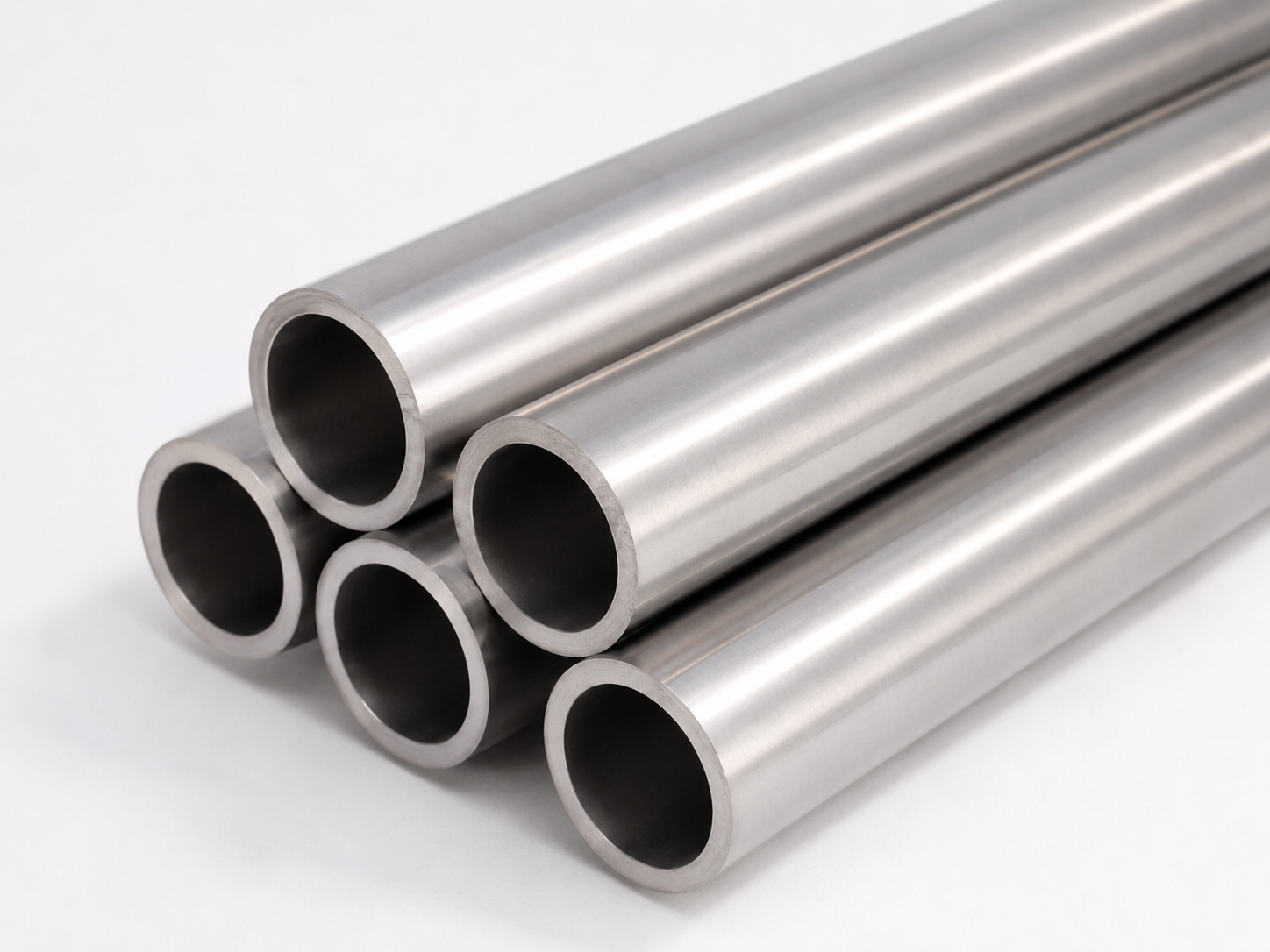
Grade 2 titanium pipe is one of the most frequently specified commercially pure titanium materials for industrial corrosion service. It is widely used in chemical processing, marine and seawater systems, heat-transfer equipment and process piping because it combines corrosion resistance, fabricability and broad product availability. For purchasing teams, however, the phrase “Grade 2 titanium pipe” is still incomplete. A usable RFQ must identify the correct ASTM product standard, dimensions, service environment, inspection scope and documentation package.
This guide is written for procurement managers, EPC teams, fabricators and maintenance buyers comparing Grade 2 titanium pipe for chemical processing. It focuses on the decisions that change price, production route, lead time and technical compliance. It does not replace a corrosion review or project code calculation; the material grade and design basis should remain under the control of the responsible engineer.
Quick Procurement Summary: What to Put on a Grade 2 Titanium Pipe RFQ
| RFQ item | What the buyer should state | Why it matters |
|---|---|---|
| Material | Titanium Grade 2 / UNS R50400 | Prevents substitution with another commercially pure or alloyed grade |
| Product route | ASTM B861 seamless pipe or ASTM B862 welded pipe | Defines the manufacturing route and acceptance specification |
| Fittings | ASTM B363 where welding fittings are required | Keeps elbows, tees, reducers and caps aligned with the piping package |
| Size | NPS / OD + wall or schedule | Allows suppliers to quote the same dimensional basis |
| Length & quantity | Random or fixed length, tolerance, pieces/meters | Changes yield, packing and total delivered cost |
| Service | Fluid, concentration, temperature, pressure, contaminants and cleaning chemistry | Supports engineering review of whether Grade 2 is the approved material |
| Inspection | Base ASTM tests + project-specific NDT / PMI / third-party witness | Affects cost, scheduling and document release |
| Documents | MTC, heat traceability, dimensional report, test reports, marking requirements | Defines what must ship with the material |
What Is Grade 2 Titanium?
Grade 2 is a commercially pure titanium grade identified as UNS R50400. It is commonly selected as a practical industrial baseline where buyers need corrosion resistance, weldability and formability without moving to a higher-alloy titanium grade. A widely used Grade 2-equivalent mill datasheet lists a minimum 0.2% yield strength of about 275 MPa and describes extensive use in seawater piping, reactor vessels and heat exchangers. The actual acceptance values for a purchase order must come from the applicable product standard and project specification.
Typical Grade 2 chemistry limits used in mill datasheets
| Element | Typical maximum, wt.% | Procurement note |
|---|---|---|
| Oxygen | 0.25 | Interstitial content is controlled because it influences strength and ductility |
| Iron | 0.30 | Controlled residual / alloying constituent within Grade 2 limits |
| Nitrogen | 0.03 | Controlled interstitial |
| Carbon | 0.08 | Controlled impurity |
| Hydrogen | 0.015 | Hydrogen control is important for titanium material quality |
Do not use a chemistry table as a substitute for certification. The supplier’s material test certificate should report the heat/lot chemistry and mechanical properties required by the ordered ASTM specification.
Which ASTM Standard Applies to Grade 2 Titanium Piping?
A complete titanium piping system can contain pipe, fittings, flanges, fabricated equipment and exchanger tubing. These are not all governed by one specification. As of 2026, ASTM lists B861-24 for seamless titanium pipe, B862-23 for welded titanium pipe and B363-23 for titanium welding fittings. Forged titanium material may be specified under ASTM B381 when the project design calls for it. Heat exchanger tube is a different product family and is generally specified under ASTM B338 rather than a pipe standard.
| Component | Common ASTM route | Buyer use |
|---|---|---|
| Seamless titanium pipe | ASTM B861 | Process piping where a seamless route is required |
| Welded titanium pipe | ASTM B862 | Project piping, including larger sizes where welded construction is practical |
| Butt-weld fittings | ASTM B363 | Elbows, tees, reducers, caps, returns and related welding fittings |
| Forged titanium material | ASTM B381 when specified | Forged components subject to project design requirements |
| Heat exchanger / condenser tube | ASTM B338 | Tube for condensers, evaporators and heat exchangers—not general process pipe |
The purchase order should identify the exact project-required edition. “Latest ASTM” is convenient in an inquiry, but it can create ambiguity when the engineering specification was frozen to an earlier edition.
Chemical Service Data Buyers Should Send Before Requesting a Quote
Titanium selection depends on the complete environment, not just the chemical name. Grade 2 performs very well in many oxidizing chloride and seawater environments, but corrosion behavior can change with temperature, concentration, aeration, deposits, crevice geometry and contaminants. Mill corrosion data are useful screening tools, yet even major titanium producers caution that laboratory data should be treated as guidance and service-specific testing may be required.
Service-condition checklist
| Service detail | What to provide | Why the supplier / engineer needs it |
|---|---|---|
| Main process fluid | Chemical name and composition | Defines the base corrosion environment |
| Concentration | Normal, minimum and maximum concentration | Corrosion behavior may change across concentration ranges |
| Temperature | Normal and upset temperature | Temperature can be a dominant corrosion variable |
| Pressure | Design and operating pressure | Needed for piping design and dimensional selection |
| Oxidizers / contaminants | Chlorides, oxidizers, metal ions, solids, organics, etc. | Minor constituents can change corrosion response |
| Flow condition | Velocity, stagnant zones, two-phase flow, solids | Helps evaluate erosion, deposits and localized conditions |
| Crevices / deposits | Gaskets, lap joints, dead legs, scaling tendency | Localized chemistry may differ from the bulk fluid |
| Cleaning / CIP | Acids, alkalis, chlorinated cleaners, temperature and frequency | Cleaning chemistry can be more aggressive than normal operation |
| Startup / upset | Temporary concentrations, dry-out, gas exposure, shutdown chemistry | Short upset periods may control material selection |
Grade 2 titanium in seawater and chloride-bearing systems
Grade 2 is widely used for seawater piping, condensers and marine equipment. This is one reason international buyers frequently search for Grade 2 titanium pipe for seawater and Grade 2 titanium pipe for chemical processing. Even so, a purchase order should not say only “for seawater.” The responsible engineer should confirm the design temperature, crevice details, flow conditions, fouling potential, chlorination practice and any galvanic interfaces.
Do not generalize from “wet chlorine” to every chlorine condition
Titanium can perform very differently in wet oxidizing chlorine-bearing conditions than in dry chlorine service. A corrosion table or previous project experience must therefore be matched to actual moisture, temperature and composition. Procurement teams should never convert a broad statement such as “titanium resists chlorine” into a material-selection rule.
Seamless or Welded Grade 2 Titanium Pipe?
Both seamless and welded Grade 2 pipe can be legitimate project choices when they are permitted by the engineering specification. The decision should be made from code, size, pressure, fabrication and QA requirements—not from a general belief that one route is always superior.
| Selection point | ASTM B861 seamless | ASTM B862 welded |
|---|---|---|
| Manufacturing route | Seamless pipe | Pipe manufactured with a longitudinal weld |
| Typical buyer reason | Project explicitly requires seamless construction or the selected size is readily available seamless | Larger diameter / project supply where welded construction is accepted |
| RFQ requirement | State B861, Grade 2, size/wall, length and inspection | State B862, Grade 2, size/wall, length, weld/QA and inspection requirements |
| What not to do | Do not substitute B338 tube because the dimensions appear similar | Do not assume a welded route is acceptable if the project specification calls for seamless |
For detailed procurement checklists, see our ASTM B861 seamless titanium pipe guide and ASTM B862 welded titanium pipe guide.
Grade 2 vs Grade 12 for Chemical Processing
Grade 2 is often the starting point for commercially pure titanium process equipment. Grade 12 is a Ti-Ni-Mo alloy commonly evaluated when the corrosion review requires improved performance in certain reducing or crevice-prone conditions. The decision should be based on actual process chemistry, temperature and equipment geometry rather than on a simple “stronger is better” rule.
| Buyer question | Grade 2 | Grade 12 |
|---|---|---|
| Material family | Commercially pure titanium | Titanium alloy with nickel and molybdenum additions |
| Common procurement role | Baseline industrial corrosion-resistant grade with broad availability | Alternative when project corrosion review calls for Grade 12 performance |
| What should drive selection | Approved corrosion data + project design | Approved corrosion data + project design |
| Buyer mistake to avoid | Assuming Grade 2 is suitable for every acid / chemical concentration | Upgrading to Grade 12 without confirming benefit, availability and fabrication requirements |
For a deeper side-by-side discussion, read Gr2 vs Gr12 Titanium for Corrosive Service.
QA, Inspection and Documentation for Grade 2 Titanium Pipe
Procurement quality requirements should be defined before commercial comparison. Adding inspection after an order is placed can change lead time, cost and even the available production route.
Minimum purchasing document package to consider
- Material test certificate (MTC): grade, heat/lot identification, chemical composition and mechanical results required by the ordered standard.
- Dimensional inspection: OD/NPS, wall thickness, length, straightness and project-specific tolerances.
- Traceability and marking: confirm how heat/lot identity must be maintained through cutting, packing and shipment.
- Base specification testing: follow the applicable ASTM pipe or fittings standard.
- Additional NDT / PMI: state any project-required positive material identification, ultrasonic, radiographic, penetrant or other inspection explicitly.
- Third-party inspection: identify the agency, hold points, witness points and document-review scope in the RFQ.
- Export documentation: define packing list, origin, inspection reports, special customer forms and other documents before final quotation.
Procurement Table: Grade 2 Titanium Pipe RFQ Template
Use this table as a purchasing checklist. Replace the examples with your actual engineering requirement; do not copy example values into a purchase order unless they match the approved design.
| RFQ field | What to specify | Example format |
|---|---|---|
| Product | Seamless or welded titanium pipe | Grade 2 seamless titanium pipe |
| Standard | ASTM B861 or B862 + required edition | ASTM B861-24 |
| Grade | Grade 2 / UNS R50400 | Grade 2 |
| Size | NPS or exact OD | OD 60.3 mm |
| Wall | Schedule / nominal wall / minimum wall | 3.91 mm nominal |
| Length | Random or fixed + tolerance | 6,000 mm fixed |
| Quantity | Pieces, meters or project take-off | 120 pcs |
| Ends | Plain, bevel, square cut, special prep | Plain ends, deburred |
| Fittings | ASTM B363 type, size, wall and quantity | 90° LR elbows, tees, reducers |
| Flanges | Type, drilling/class, facing, material basis | Weld neck / ASME pattern per project |
| Service | Fluid, concentration, temperature, pressure, contaminants | Chemical process transfer line |
| Inspection | ASTM base scope + project additions | MTC + dimensional report + project NDT |
| Packing | End protection and export packing | Seaworthy export packing |
| Commercial terms | Incoterm, destination, requested delivery | FOB / CIF + destination port |
Eight Common Grade 2 Titanium Pipe Buying Mistakes
- Sending “Grade 2 titanium pipe” with no ASTM standard. Suppliers may quote different manufacturing routes.
- Choosing Grade 2 from a generic corrosion chart only. Service chemistry, temperature and upset conditions still require engineering review.
- Mixing pipe and heat exchanger tube specifications. ASTM B861/B862 pipe and ASTM B338 tube are not interchangeable purchasing descriptions.
- Leaving wall basis unclear. State schedule, nominal wall or minimum wall and the dimensional system.
- Ignoring fittings and flanges until later. Quote the whole piping package early to check dimensional and material compatibility.
- Adding PMI, third-party inspection or special NDT after price approval. These requirements can change cost and production scheduling.
- Not stating service conditions. The supplier cannot intelligently flag an obvious material/specification mismatch without basic process information.
- Comparing only price per kilogram. Compare usable length, compliance, testing, certificates, packing, delivery and total project value.
Related Grade 2 Titanium Products and Buyer Guides
FAQ: Grade 2 Titanium Pipe for Chemical Processing
What ASTM standard is used for Grade 2 titanium pipe?
For process pipe, ASTM B861 covers seamless titanium pipe and ASTM B862 covers welded titanium pipe. Grade 2 / UNS R50400 is included in these product families. The purchase order should state the project-required edition.
Is Grade 2 titanium suitable for chemical processing?
Grade 2 is widely used in chemical-processing equipment and piping, but suitability is service-specific. Fluid composition, concentration, temperature, contaminants, crevices, deposits, cleaning chemistry and upset conditions should be reviewed by the project corrosion/materials engineer.
Is Grade 2 titanium good for seawater piping?
Grade 2 is widely used in seawater piping and marine heat-transfer systems. The final design should still evaluate temperature, velocity, crevices, fouling, chlorination practice and system interfaces.
What is the difference between ASTM B861 and ASTM B862?
ASTM B861 is the seamless titanium pipe specification; ASTM B862 is the welded titanium pipe specification. Use whichever manufacturing route is approved by the project design rather than treating them as interchangeable.
Which ASTM standard covers Grade 2 titanium fittings?
ASTM B363 covers seamless and welded unalloyed titanium and titanium-alloy welding fittings such as elbows, tees, reducers, caps and related butt-welding components.
When should a buyer consider Grade 12 instead of Grade 2?
Grade 12 may be evaluated when the corrosion review requires improved performance in particular reducing or crevice-prone conditions. The decision should be based on approved corrosion data and process conditions, not on grade number alone.
What information should I send for a Grade 2 titanium pipe quotation?
Send the ASTM standard and edition, Grade 2, size, wall, length, quantity, end condition, fittings/flanges, process fluid, concentration, temperature, pressure, inspection, documentation, packing, Incoterm and destination.
Can TAILIDEXIN quote a complete Grade 2 titanium piping package?
Send the pipe schedule or exact dimensions, fittings and flange list, quantities, standards, inspection requirements and delivery destination. TAILIDEXIN can review the requested product mix and confirm the quotation basis for available items.
Request a Grade 2 Titanium Pipe Quotation
Send TAILIDEXIN your ASTM standard, Grade 2 material requirement, pipe size and wall, length, fittings/flanges, quantity, service conditions, inspection scope and destination. A complete RFQ helps us quote the correct manufacturing route and documentation package the first time.
Technical information in this article supports procurement communication only. Final material selection, corrosion suitability, pressure design, code compliance and acceptance criteria should follow the project engineer, applicable code, current standard edition and purchase specification.